Surfshark vs ProtonVPN comes down to one question: do you want the best all-round value, or do you want the most privacy-focused brand? For most people, Surfshark wins — it’s cheaper, allows unlimited devices, and is easier to use every day. ProtonVPN is the right call if maximum transparency and a Swiss-based open-source VPN matter more to you than saving money.
Quick answer: Surfshark is the better pick for most users — it’s cheaper on long-term plans (currently from $1.99/mo), supports unlimited devices, and is simpler to use. ProtonVPN is worth it if you want a Swiss-based open-source VPN or need a genuinely free tier with no data limits. Check current deals before you commit — offers change.
The 30-second verdict
Both VPNs are genuinely good. Both use AES-256 encryption, have strict no-logs policies, support WireGuard and OpenVPN, and work on all major platforms. Neither is a bad choice.
The difference is what each one is built for. Surfshark is built to be the best everyday VPN for normal users — fast, affordable, flexible, beginner-friendly. ProtonVPN is built around a privacy-first identity — open-source code, a Swiss legal base, and a reputation earned by the same team behind Proton Mail.
If you want the better deal for most real-world situations, Surfshark is the winner. If transparency and the Proton ecosystem matter more than price, ProtonVPN earns that trust.
Try Surfshark for less
Better value, unlimited devices, strong privacy — Surfshark is the easier pick for most people.
Price and value
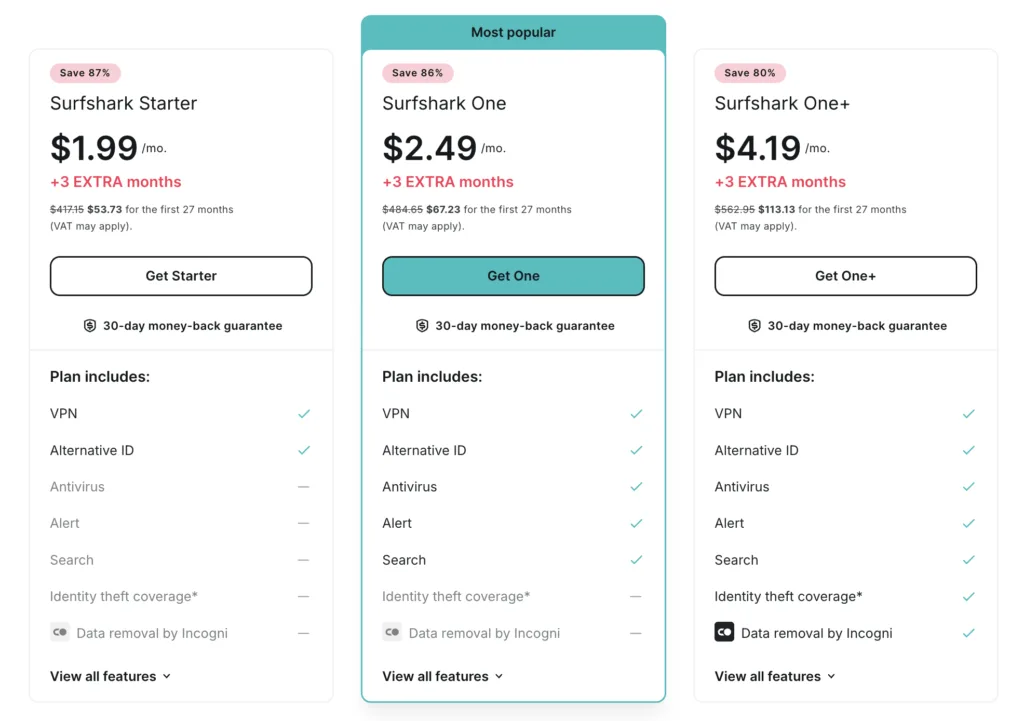
This is where the gap between the two VPNs becomes obvious. Surfshark’s 2-year Starter plan is currently $1.99/month ($53.73 for the first 27 months, which includes 3 bonus months). ProtonVPN’s VPN Plus 2-year plan is $2.99/month ($71.76 for the first 24 months). Both renew at higher rates after your first term — check each site before you commit.
| Surfshark Starter | ProtonVPN Plus | |
|---|---|---|
| 2-year plan | $1.99/mo | $2.99/mo |
| 1-year plan | $3.19/mo | $3.99/mo |
| Monthly | $15.45/mo | $9.99/mo |
| Devices | Unlimited | Up to 10 |
| Free tier | 7-day trial (mobile) | Yes — unlimited data |
| Money-back | 30 days | 30 days |
One thing worth flagging: Surfshark’s monthly plan is actually more expensive than ProtonVPN’s ($15.45 vs $9.99/mo). If you only want a short-term subscription, ProtonVPN is the cheaper option. The value calculation only flips in Surfshark’s favour on 1-year or 2-year plans.
Privacy and trust
Both VPNs have strong no-logs policies and have passed independent audits. The real difference is how they communicate that commitment.
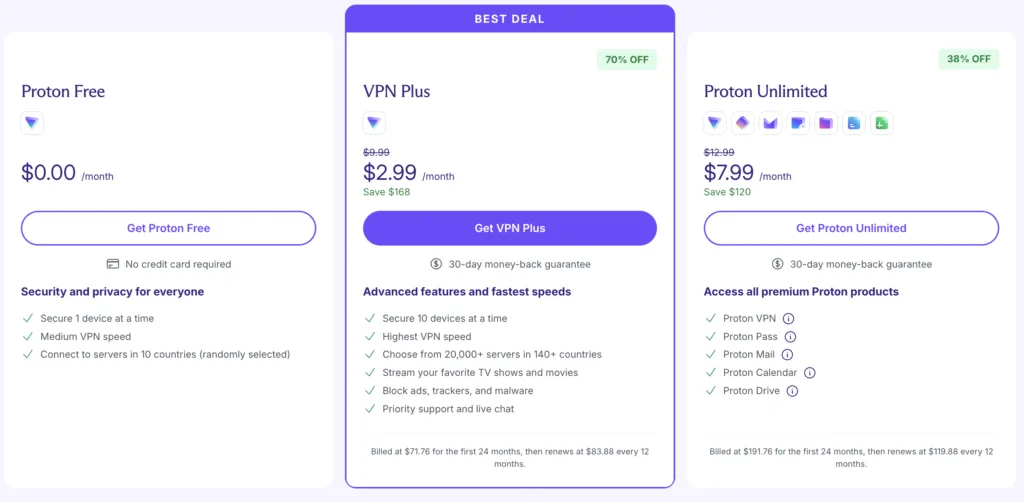
ProtonVPN leans hardest into the privacy-first identity. It’s based in Switzerland — outside EU and US jurisdiction — its apps are fully open-source (you can read the code), and it’s built by the same team behind Proton Mail. If you want the most transparent VPN company, Proton has earned that reputation. It also has a genuine free plan: unlimited data, no ads, no selling your info, one device at a time, servers in 10 countries. That free tier is unusually good for a privacy-first product.
Surfshark is not weak on privacy. It uses RAM-only servers (no data survives a reboot), has a strict no-logs policy, and has undergone independent audits. It is based in the Netherlands — less symbolically loaded than Switzerland, but still a reasonable privacy jurisdiction. The difference is that Surfshark positions itself as a mainstream VPN that happens to take privacy seriously, while ProtonVPN positions privacy as its entire reason for existing.
Speed and streaming
For most everyday users, both are fast enough that you won’t notice a VPN is running. Independent tests give Surfshark a slight edge on speed for most users — it’s upgraded its entire network to 10Gbps servers and consistently retains over 90% of base speed in testing. ProtonVPN is competitive, and some tests give it the edge on long-distance connections, but for typical browsing, streaming, and video calls, Surfshark is the easier recommendation.
For streaming, Surfshark is more reliable. It consistently unblocks Netflix libraries, Disney+, BBC iPlayer, and other major platforms. ProtonVPN can do the same on paid plans, but users report needing to switch servers more often. If streaming is a primary reason you’re getting a VPN, Surfshark has the edge.
Features side by side
| Feature | Surfshark | ProtonVPN |
|---|---|---|
| Ad/tracker blocker | CleanWeb | NetShield |
| Privacy routing | MultiHop | Secure Core |
| Kill switch | Yes | Yes |
| Protocols | WireGuard, OpenVPN, IKEv2 | WireGuard, OpenVPN, IKEv2, Stealth |
| Open source | No | Yes |
| Free tier | No (7-day mobile trial) | Yes — unlimited data |
| Devices | Unlimited | 10 (paid) / 1 (free) |
| Servers | 4,500+ in 100 countries | 20,000+ in 148 countries |
| Based in | Netherlands | Switzerland |
ProtonVPN’s Stealth protocol is worth noting if you’re in a country that blocks VPN connections — it disguises your traffic so it doesn’t look like a VPN. Surfshark doesn’t have a direct equivalent. ProtonVPN also has a significantly larger server network (20,000+ vs 4,500+), which matters for torrenting and finding less-congested servers.
Cost over two years
The most honest comparison is total spend over a realistic subscription window, including what happens at renewal.
| Surfshark Starter | ProtonVPN Plus | |
|---|---|---|
| First term (2-yr deal) | $53.73 / 27 months | $71.76 / 24 months |
| Annual renewal rate | ~$79/yr (Starter) | ~$83.88/yr |
| Effective monthly (2-yr) | ~$1.99/mo | ~$2.99/mo |
Surfshark is cheaper across all long-term plan lengths. The renewal caveat applies to both — neither company keeps the intro discount on renewal, so factor that into your decision if you plan to stay subscribed for several years.
Try ProtonVPN free
ProtonVPN has a genuinely free tier — unlimited data, no credit card needed.
What I found testing both
After testing both Surfshark VPN and ProtonVPN, the major differences were Surfshark’s faster and more stable servers and a simpler UI. I liked Surfshark’s mobile app as well, which was very intuitive and easy to use. On the other hand, ProtonVPN had better privacy options and more servers and countries to choose from – this could be a huge advantage to some users, but I personally didn’t need servers in very specific and smaller countries. Also, ProtonVPN has a free plan, so it is completely free to test (and use). Surfshark, in my opinion, is the best value and all-in-one VPN tool from all the major VPNs on the market.
Who should pick Surfshark
- You want the lowest price on a long-term plan
- You have multiple devices — phone, laptop, tablet, TV — and want them all covered on one account
- Streaming is a priority and you want something that just works
- You’re new to VPNs and want the simpler, more beginner-friendly app
- You want 24/7 live chat support
Up to 87% off + 3 months free
Lock in the Surfshark deal before it changes. Check the current offer at the link.
Who should pick ProtonVPN
- Privacy transparency is your top priority and you want an open-source, audited VPN
- You’re already in the Proton ecosystem (Proton Mail, Proton Drive) and want everything under one account
- You want a genuinely free VPN with no data limits and no strings attached
- You need the Stealth protocol to use a VPN in a country that blocks them
- You prefer a larger server network (20,000+ servers) for torrenting or niche server locations
Frequently asked questions
Is Surfshark better than ProtonVPN?
For most users, yes. Surfshark offers unlimited device connections, lower pricing on long-term plans, faster speeds for streaming, and a simpler app. ProtonVPN is the stronger pick if your top priority is maximum privacy transparency — it’s open-source, based in Switzerland, and has a genuine free tier.
Does ProtonVPN have a free plan?
Yes. ProtonVPN offers a genuinely free tier with unlimited data, no credit card required. Free users get one device connection, medium speeds, and access to servers in 10 countries (randomly selected). It’s one of the few free VPNs that doesn’t log or sell your data.
Which is cheaper — Surfshark or ProtonVPN?
Surfshark is cheaper on paid plans. The 2-year Starter plan is currently $1.99/month ($53.73 for 27 months including 3 bonus months), while ProtonVPN’s VPN Plus 2-year plan is currently $2.99/month ($71.76 for 24 months). Both renew at higher rates after the first term — check each site for current renewal pricing.
Can I use Surfshark on unlimited devices?
Yes. All Surfshark plans include unlimited simultaneous device connections on one subscription. ProtonVPN’s paid plans cap connections at 10 devices, and the free plan allows only 1 device at a time.
Is ProtonVPN good for streaming?
ProtonVPN can unblock major streaming platforms like Netflix and BBC iPlayer on paid plans, but Surfshark is generally more consistent for streaming — it reliably unblocks Netflix, Disney+, and other services with fewer server switches needed.
Related next step
Browse all our VPN reviews and guides, or check the current VPN deals to see what’s on offer before you subscribe.