

To start an LLC in Texas, file a Certificate of Formation (Form 205) with the Texas Secretary of State and pay the $300 state fee. You also need a registered agent with a Texas street address, a free EIN from the IRS and, every year by May 15, a Public Information Report to the Texas Comptroller. With Northwest Registered Agent, you can form your LLC for $39 plus state fees, with a full year of registered agent service included.
Texas moved its business filings to a new system, SOSPortal, on September 29, 2026 (it replaced SOSDirect). Older guides show screens that no longer exist; everything below was checked in November 2026.
Northwest Registered Agent
Form your LLC for $39 + state fees, with a full year of registered agent service included.
Texas LLC costs at a glance
| Cost | Amount | Notes |
|---|---|---|
| Certificate of Formation (Form 205) | $300 | State fee, the same whether you file yourself or use a service |
| Card payment on SOSPortal | About 2.7% | Card processing fee when you file yourself; ACH is also accepted |
| Northwest formation | $39 | Includes a year of registered agent service; renews at $125/year |
| Name reservation (optional) | $40 | Holds a name for 120 days |
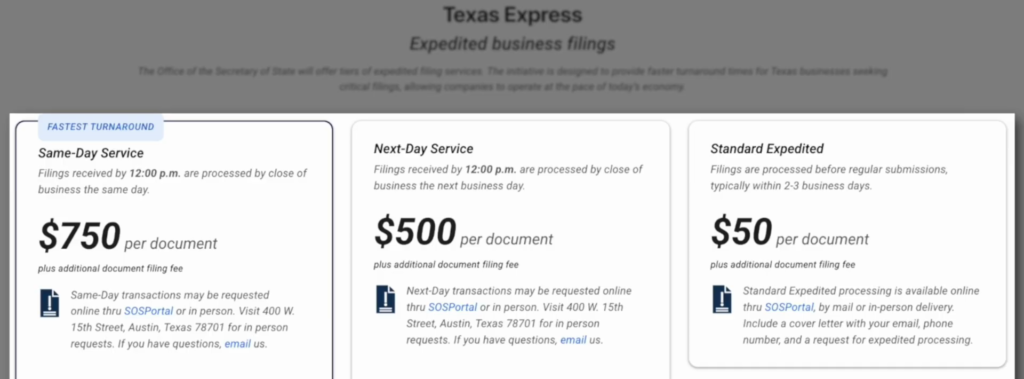
| Expedited handling (optional) | $50 to $750 | Per document, on top of the filing fee |
| EIN | $0 | Free from the IRS ($50 if Northwest files it) |
| Franchise tax | $0 for most new LLCs | No tax due at or below $2.65 million revenue (2026 and 2027 reports) |
| Public Information Report | $0 | Due May 15 every year |
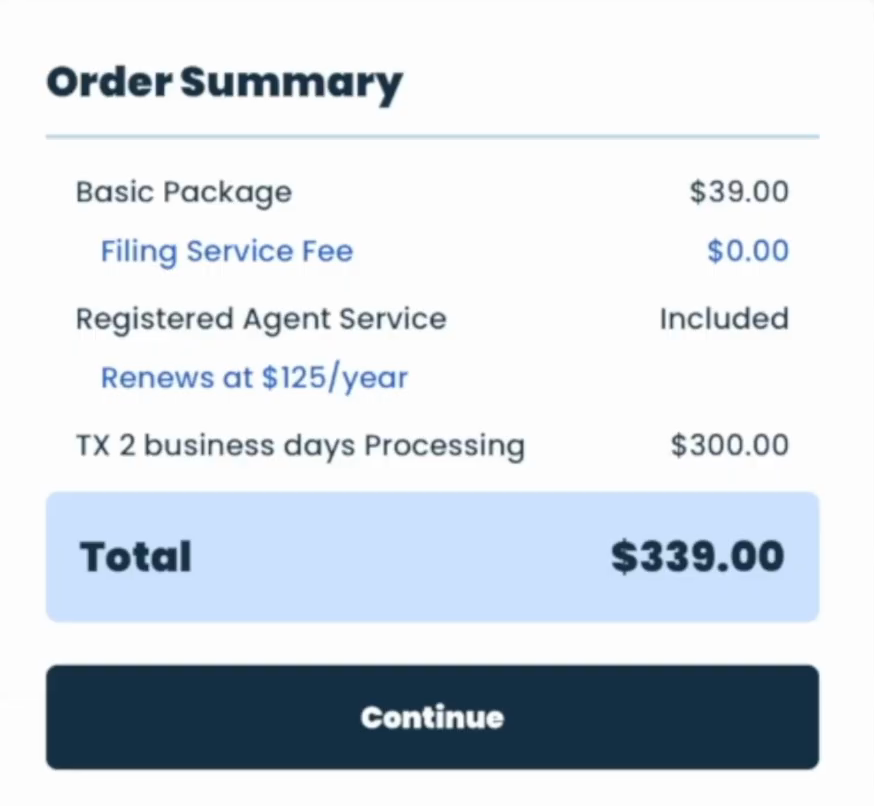
Through Northwest the order total is $339: the $39 formation package plus the $300 Texas fee, which Northwest pays to the state when it files.
Step 1: Choose your Texas LLC name
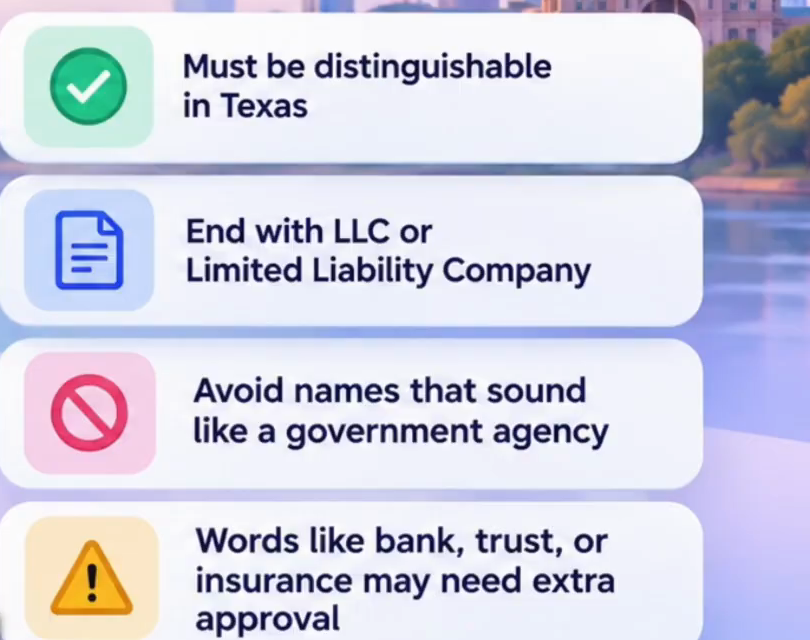
- The name must be distinguishable from every other business already registered in Texas.
- It must end with a designator: Limited Liability Company, Limited Company, or an abbreviation such as LLC.
- Avoid words that make you sound like a government agency.
- Words like bank, trust or insurance can need extra approval before the state accepts them.
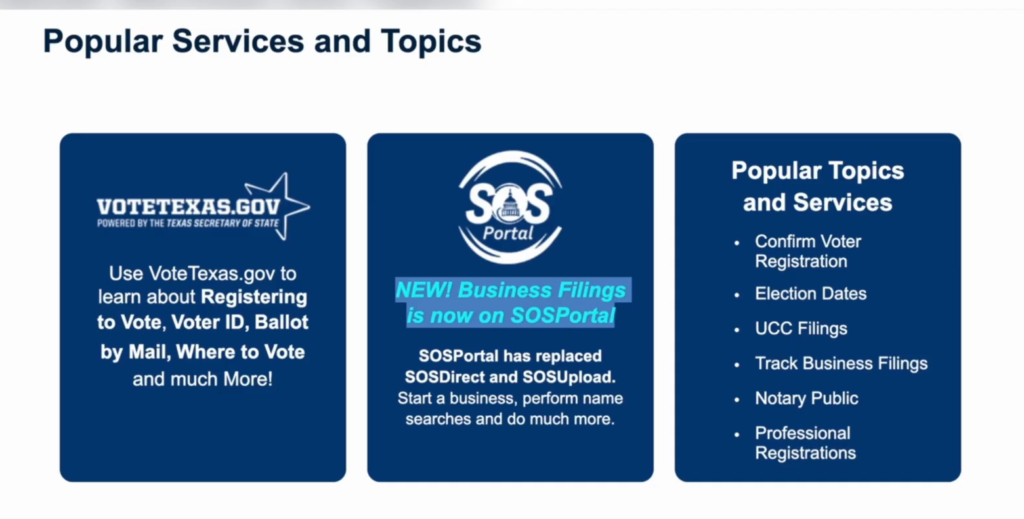
The official name search now lives inside SOSPortal (you need a free account, and searches carry a small fee). For a free first check, use the Comptroller’s taxable entity search. Then check the domain, the social handles and the USPTO trademark database: you don’t need a trademark to form an LLC, but you don’t want to build a brand on a name someone else owns.
Step 2: Pick a registered agent
Every Texas LLC needs a registered agent: a person or company with a physical Texas street address (not a P.O. box), available during business hours, who receives state mail and legal papers, including service of process if the LLC is sued. You can be your own agent for free, but your name and address go on the public record and you have to be reachable every business day.
Most owners use a service. Northwest puts its Texas address on your filing instead of your home address, scans state and legal mail to your account, and includes the first year when it forms your LLC (then $125 a year). Formation also comes with a free domain, website, business email and phone line. More detail in our Northwest Registered Agent review.
Step 3: File the Certificate of Formation (Form 205)
Form 205 is the filing that creates your LLC. You can file it yourself on SOSPortal or have a service file it; the $300 state fee is the same either way. With Northwest the order takes a few minutes:
- Open Northwest and choose to start your LLC.
- Set the entity type to LLC and the state to Texas. The order summary shows the $39 basic package, a $0 filing service fee, registered agent service included (renews at $125 a year) and the $300 Texas fee.
- Type your company name and pick the designator. The preview shows exactly how the name will appear on state records, so check the spelling.
- Decide on the EIN add-on (step 4).
- Create your account: name, a phone number for two-factor sign-in, email and password.
- Check the order summary once more, pay and submit. Northwest prepares and files the certificate.
In late October 2026, Texas online filings were coming back within a few business days. If you can’t wait, the state sells expedited handling; most people don’t need it.
Step 4: Get your EIN
The EIN (employer identification number) is your LLC’s tax ID. You need it to open a business bank account, file taxes and hire employees. It is free when you apply yourself on IRS.gov once the LLC is approved, and the online form takes a few minutes. Northwest’s EIN filing add-on costs $50 if you’d rather not deal with the IRS at all.

Step 5: Sign a company agreement
Texas law calls the operating agreement a company agreement. It isn’t required and you never file it with the state, but without one the default rules of the Texas Business Organizations Code decide how your LLC is run. Put ownership percentages, decision-making, profit splits and what happens if someone leaves in writing. Single-member LLCs should have one too, because it helps show the LLC is a separate business.
Step 6: Open a business bank account
Bring your certificate of formation, your EIN and your company agreement; most banks ask for all three. From day one, every dollar the business earns goes into that account and every business expense comes out of it. If you mix personal and business money, a court can decide the LLC isn’t truly separate, which puts your personal assets at risk. Use a business card for business purchases, keep receipts and do simple monthly bookkeeping.
Step 7: Keep the LLC in good standing (May 15)
Texas has no traditional annual report with the Secretary of State. Instead, every LLC files with the Texas Comptroller by May 15 each year, starting the year after it forms.
- Franchise tax: for reports due in 2026 and 2027, the no tax due threshold is $2.65 million in total revenue. At or below it, you owe no franchise tax.
- No Tax Due Report: no longer filed. Texas eliminated it for reports due on or after January 1, 2024.
- Public Information Report (PIR): still required (or an Ownership Information Report, depending on the entity). It’s free, but skipping it can cost your good standing and eventually the right to do business in Texas.
- Sales tax permit: free from the Comptroller if you sell taxable goods or services.
- Beneficial ownership report: companies formed in the United States are currently exempt from the federal BOI report. Rules like this can change, so check FinCEN before you rely on it.


Do it yourself vs Northwest
| Do it yourself | With Northwest | |
|---|---|---|
| Upfront cost | $300 + card fee | $339 ($39 + $300) |
| Address on the public filing | Yours, if you are your own agent | Northwest’s Texas address |
| Registered agent | You, every business day | Included for year one, then $125/year |
| Filing | You, on SOSPortal | Northwest files for you |
| Compliance reminders | Your own calendar | Northwest sends them |
What I’d do
I’d file through Northwest for the $39 mainly for the address. Texas puts the registered agent’s address on a public filing, and a home address is hard to get back off the internet once it’s out. The $300 state fee is the same either way.
I’d skip the $50 EIN add-on, since the IRS form is quick, and I’d set two reminders right away: May 15 for the Public Information Report, and a month before the registered agent renews. I’m not a lawyer or an accountant: with several owners, have an attorney review the company agreement, and once profits grow, ask a CPA whether an S corp election makes sense.
Start your Texas LLC
$39 + state fees, with a full year of registered agent service included.
FAQ
How much does it cost to start an LLC in Texas?
The state fee for the Certificate of Formation (Form 205) is $300. Through Northwest the total is $339 ($39 + $300), with the first year of registered agent service included. After that: no franchise tax at or below $2.65 million in revenue, a free Public Information Report each May 15, and $125 a year for Northwest’s registered agent service from year two.
How long does it take to form an LLC in Texas?
In late October 2026, online filings were being processed within a few business days. The state also sells expedited handling, from standard expedited up to same-day service, for an extra fee per document.
Does a Texas LLC have to file an annual report?
Not with the Secretary of State. Instead, file with the Texas Comptroller by May 15 every year, starting the year after you form. At or below the $2.65 million threshold you owe no franchise tax and no longer file a No Tax Due Report, but the Public Information Report is still required.
Can I be my own registered agent in Texas?
Yes, if you have a physical Texas street address and are available during normal business hours. Your name and address then appear on the public record, which is why most owners use a registered agent service.
Do I need an operating agreement in Texas?
Texas calls it a company agreement. It isn’t required and isn’t filed with the state, but it’s strongly recommended, including for single-member LLCs: without one, the default rules of the Texas Business Organizations Code apply.
What is SOSPortal?
SOSPortal is the Texas Secretary of State’s online system for business filings, orders and searches. It replaced SOSDirect and SOSUpload on September 29, 2026.
Related next step
Still choosing a provider? Compare the best LLC services by 3-year cost or read our Northwest Registered Agent review. For the full Northwest walkthrough, see how to start an LLC with Northwest; more formation guides are in the LLC hub.